The Mourning Moonlight, LLC
The Light in the Night Sky
When Life Interrupts Us
This piece is a written reflection shaped by interruption. It's an inner monologue formed during injury, rest, and uncertainty. It explores the quiet thoughts that surface when life slows without permission, and the ways injury, grief, diagnosis, and loss reshape how we move through the world. This is not a guide, but a shared pause. An invitation to reflect on how we adapt when life interrupts us.
Violetta Gijon RN, BSN
1/11/202610 min read
"We must stop regarding unpleasant or unexpected as interruptions of real life. The truth is that interruptions are real life. "
- C. S Lewis


We often move through life believing that things will continue as they are. We make plans, set schedules, and imagine the future as a natural extension of the present. Within all of this, there is the unspoken sense of control. A belief that if we do things right, move fast, stay disciplined, “rub some dirt on it”, and keep moving forward – life will cooperate.
Until it doesn’t.
I am sure that we have all hit a point in our lives where life hits us like a bag of bricks. Unexpectedly and out of nowhere. And we take that hit hard.
Life has a way of interrupting us without warning nor does it ask permission to change before it does. An injury that stops the body mid-stride. A diagnosis that puts the future in question. A death that splits time into before and after. These moments arrive uninvited, dismantling the rhythm we were living by and asking us to orient ourselves to a reality we did not choose.
These times are a tough pill to swallow because we did not ask for these things to happen, they just did. Survival becomes work. Not in a dramatic sense, but biologically. You now are faced with something you didn’t plan. You’re faced with a situation that you have never experienced before, which means you more than likely don’t have the resources to maneuver through this situation. And now, you’ll have to figure out ways to adapt to this new, unexpected situation to survive.
We all know logically, that in today’s world we can’t just simply stop our lives when something unexpected occurs. Bills still exist. Responsibilities remain. The world keeps moving, regardless of what we are carrying. And yet, I find myself asking: why do we live as though interruption is rare, when it is inevitable?
I am just as guilty of this belief as anyone else.
Despite years of working in the medical field, knowing that change, illness, injury, and catastrophic events can happen at any given moment. Without rhyme or reason. I still live with the quiet assumption: “This won’t happen to me.” I believed it even while knowing better. And perhaps this is where “ignorance is bliss.” Perhaps that ignorance – acting as though interruption is something distant, unlikely, or belonging to someone else – is part of how we survive. To move through the world without constantly bracing for impact. We tuck these possibilities away, not because they aren’t real, but because carrying them at forefront of our minds would be unbearable. Living in constant fear is not ideal.
The illusion is not that life should be predictable, but that we forget it isn’t. When interruption arrives, it doesn’t just change our circumstances, it changes how we move through this world. How we understand ourselves and others.
When Everything Changes
The moment everything changes, it is often not dramatic, though it can be. There isn’t a warning nor a preparation time. You’re just thrown into it. One ordinary day and suddenly, the stability you thought you had, is now uncertainty. The future becomes cloudy. The body you trusted no longer responds the way it used to. And life is not what it was before any of this occurred.
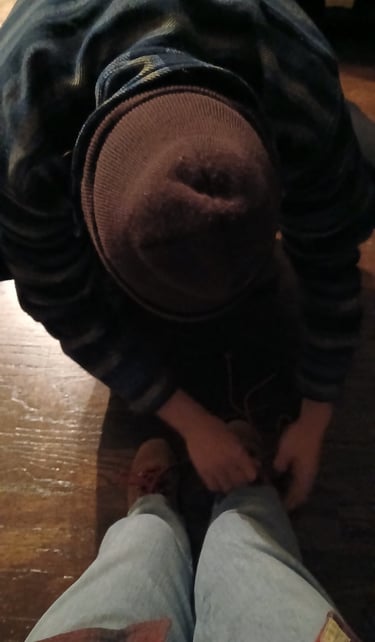
For me, it was a back and hip injury. Not the result of my reckless pastimes, aerial & circus performance, or even neglect (the doctor believes so, ha-ha). I believed that I was living in a body that was strong and well cared for. I ate well. I exercised. I hydrated. Stretched. I did the things we are told will protect us. And still, one wrong movement was enough to cause significant injury. Enough to reduce my mobility, limit my independence, and to reshape my daily life in ways I had never fully understood until I was living inside them. I am no stranger to injury, but this was unlike anything I had experienced before.
The surprising part was not the pain itself, but how much of life became difficult all at once. The pain was excruciating. When they say, “Back pain is no joke.” I now understand this deeply. It affected my mobility, function, energy, and my mental/emotional. The simplest of actions became the most difficult actions to perform. It made ordinary moments into exhausting negotiations with my own body. I found myself watching people walk and wishing I could too without discomfort. In those moments, I found myself understanding all the people I have cared for in a new way. I finally understood what my clients meant when they spoke about the loss of mobility. About needing a walker and wishing deeply that they could one day walk freely too. I understood the sense of earning for normalcy.
In my experiences, within the medical field, back pain is a topic I am most familiar with. In the emergency department, back pain is often triaged as a lower acuity, but it’s dependent on the presentation. It can be given a triage ranging from 3 – 5, where levels 4 and 5 are considered non-emergent and do not require resources (labs, EKGs, medications, etc.). I have heard countless negative stories from individuals who have gone into the ER for back pain. They often express a sense of dismissiveness and skepticism from the medical team. As someone who has worked here, I may be able to tell you why that is. The ER has seen repeat visits. They have encountered drug-seeking behaviors. And the ER is a system that is designed to prioritize life-threatening events. The ER has approximately 3 hours to stabilize, treat, discharge, or admit you. Nothing less and nothing more. And the ER is not a place that can help with ongoing issues.
I understand how this can sound harsh, even cold. Because while back pain may not always be emergent in the way we define medical urgency, it can be profoundly life-altering for those truly experiencing it. The pain is consuming, and it interferes with mobility, sleep, and spinal stability. It strips aways independence and demands constant attention. You use your back constantly in your day-to-day life! It becomes impossible to separate physical pain from emotional exhaustion when every movement carries weight.
This firsthand experience has brought a deeper awareness of how easily suffering can be minimized when it does not fit neatly into systems built on urgency, convenience, and efficiency. And I am not just talking about the emergency department, but also about the systems/culture of society. But this experience is only one small glimpse into one person’s life, mine. Variations of this interruption are happening every day, on a much larger scale. Through injury, new diagnoses, and death. These unexpected events are life-altering. Reshaping how people move through their bodies, their relationships, their work, and their sense of self. These situations don’t affect a small portion of people’s lives; it ripples outwards affecting every portion of their life.
Perception can change when you go from being the observer to the one who inhabits the pain or suffering.
The Harm of a Constant – Go Culture
The difficulty is not only in the interruption, but the world we are expected to reenter. We live in a culture that values productivity, movement, and resilience. This constant-go culture leaves little room for the realities of injury, illness, or loss. Recovery is expected to be efficient. Grief is to be brief. We are praised for “pushing through,” even when doing so causes harm. I am guilty of this, and possibly many others are as well.
In this culture, slowing down is framed as a weakness. Rest is something to justify; “I can sleep when I’m dead.” When life interrupts, we are often trying to learn how to heal, grieve, or adapt to new ways of living all while being expected to perform as if nothing has happened.
Before moving forward, take a moment to reflect on your own experiences. Think about a time in your life when something unexpected occurred. Something that was minor or something that altered everything. In what ways did this have an impact on your day-to-day life? How did it affect your energy, your focus, your ability to show up as you once did? When you reentered the roles, you held before that interruption. At work? At home? In relationships? What was that experience like?
Did you need additional resources such as support, accommodations, therapy, or any resources that may be needed for navigating that transition. Were those needs acknowledged, or were you expected to resume life as usual? Many people find that the most difficult part is not the interruption itself, but the tension from the expectation to reenter a world that did not pause with them.
One example that proves the tension we may experience is how grief is managed. Typically, we are allotted three to five days for immediate family (spouse, child, or parent). One to Three days for extended families or friends. But at the same time, none of this is mandated and varies from employer to employer. Even though these experiences can permanently alter a person’s inner and outer world. The timeline imposed does not align with the reality of grief, just as timelines for healing rarely align with the lived experience of recovery.
In my career as a nurse, I have attended the days when life decides to interrupt. I have seen change brought on suddenly; unanticipated change. But I have been witness to the aftermath. Families who have lost loved ones who are now needing to decide on arrangements, while grieving, and wondering how they will continue with the loss. Someone has who has been given a new diagnosis or has suffered an injury. Needing to find resources and taking on the emotional toll that is the result from limited physical and mental function. These experiences can affect concentration, energy, emotional regulation, sleep, and physical capacity. They change how people show up and function in their day-to-day life. And when systems do not recognize this, people are left carrying both their pain and the belief that their struggles are a personal failing. We are often our own worst critic. And not living up to the standards or expectations of the constant-go culture can put an emotional toll on people.
This culture is not a space that allows for interruptions, it teaches us to override ourselves. It teaches us to silence our pain at times, minimize our grief or move past it, and to treat rest as indulgence rather than necessity. Over time, this disconnect can do more harm than good. And I can’t be the only one who believes this. In result this causes disconnection from the body, your emotions, and your lived reality. The problem is we don’t need time, but our society does not allow that time.
How Do We Move With These Interruptions?
If life’s interruptions are inevitable, how do we learn to move with them? How do we continue forward when life no longer looks the way it did? How do we live inside injury, grief, or uncertainty in a world that rarely slows down to meet us where we are?
For me, this question became personal after this past injury. It required me to set aside my independence. To ask where help was needed. Though my mind said I could, my body argued that it wasn’t able to perform the mundane tasks that once seemed so simple. I found myself in constant frustration because the strength I once worked to build was no longer present. I found myself napping wherever a nap could be taken. Naps and rest became non-negotiables. I had to conserve my energy wherever I could so that I could put the little energy I had into what mattered most in that time. All to say, it was a humbling, and continues to be, a humbling experience.
Moving with interruption taught me that energy is not infinite. That there are days when choosing one thing means letting go of several others. Constant sacrifice and a mental battle of “letting go.” Letting go of the control. Pushing through was no longer a possibility; listening became the work. Learning to be softer with myself during a long road to recovery. The shift required boundaries, clear ones, with myself and with what I could and could not offer, even when my instinct was to keep showing up as I had before.
Prioritizing self-care – not the self-care that involves bubble baths and chocolates- the self-care that involves honesty. Honesty with yourself about the things you need to survive and recover. It challenged long-held beliefs about productivity, responsibility, and worth. And I want to be clear: this approach is not universal. What healing, rest, and adaptation looks like, varies from person to person. But for me, honoring rest, support, and new ways of body awareness are essential for me.
It continues to be a difficult challenge. Learning to move with interruption did not mean mastering it or making peace with it quickly. It meant developing a relationship with a body and life that needed something different than before. Because what was working before was no longer suiting the current situation. It meant accepting that movement might look slower, smaller, and may be more challenging. Trusting that this, too, was a valid way of continuing to move forward rather than at the typical speed and norm.
What the Pauses Asks of Us
Perhaps what life’s interruptions ask of us is not certainty, answers, or resilience. But openness. Openness to listening, witnessing, and to allowing stories to exist without the need to fix or compare.
While this reflection has been shaped by my own personal experience, it is not a story about me alone. It is a story about people. The way individuals learn to live inside injury, grief, diagnosis, and any other unexpected life events. Every interruption carries its own weight. And every person meets it differently. There is no singular path, no correct response, no universal timeline.
One of the greatest teachers in my life has been listening. In grief groups, in conversations, and in moments where people feel safe to share what they have they have lived through. I am continually reminded that adaptation looks different for everyone. Hearing how others navigate interruptions helps expand my understanding of humanity. It reshapes how I think about care, resilience, and survival.
These stories matter. Not because they fit into a narrative of overcoming, but because they reflect the reality of being human. That there is wisdom in listening to the experiences of others.
If you feel moved to reflect on your own experiences, I highly encourage you to do so. Whether it’s about injury, grief, diagnosis, or another unexpected turn in life. Know that your story has value. Not as something to be polished or resolved, but as something that deserves to be heard because it’s hard work and effort just to survive in today’s world. This space is shaped by those voices and continues to grow through shared community and understanding and I would love to hear from you all. I want to hear other expereinces or thoughts you may have.
This is not my story alone.
It is the story of people learning how to live when life interrupts them.